Dementia · Live-in · Family guide
Live-in care for dementia: a family's practical guide
A family's practical guide to dementia care at home, how live-in care preserves routine, what each stage needs, and how to plan the first weeks.

A recent dementia diagnosis rearranges everything. You start scanning the days ahead for risks you didn't notice last month: the cooker left on, the front door unlocked, the same question asked four times before lunch. This guide walks through what good dementia care at home actually looks like, stage by stage, and where live-in care fits, and where it stops fitting. We won't tell you what to feel. We will tell you what tends to work, what tends to break, and the questions worth asking before week one even starts.
Why live-in suits dementia care at home
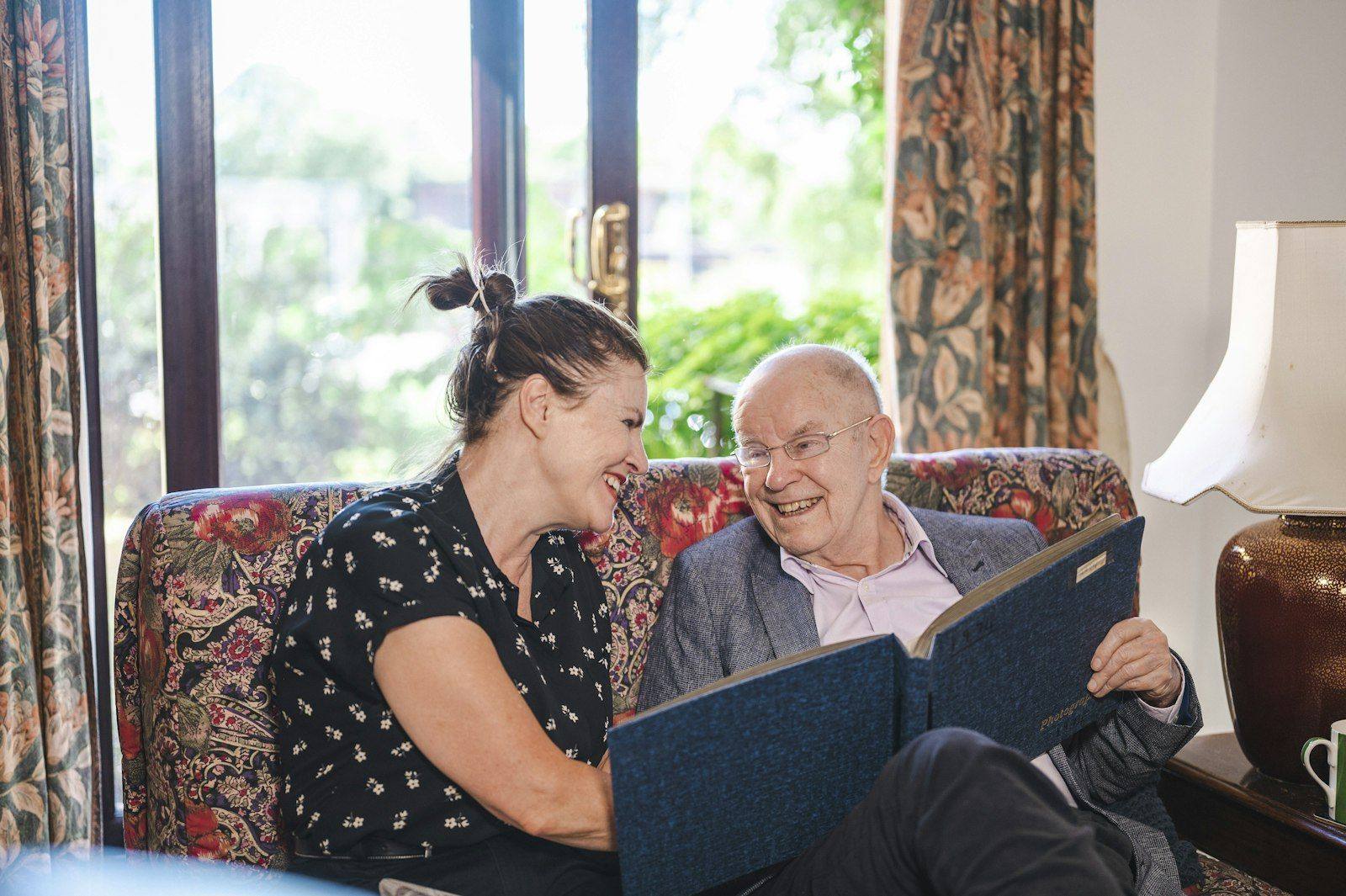
The single most disruptive thing for someone with dementia is unfamiliarity. New rooms, new routes to the bathroom, new faces: all of it costs cognitive effort that's already in short supply. The case for what live-in care actually involves gets stronger with dementia because it removes that disruption almost entirely. Your loved one stays in the home they know. The garden they planted. The chair by the window.
A live-in carer also means continuity of face. With MeddyCare's two-carer model, one or two known carers rotate per household, not a different agency worker each shift. The Alzheimer's Society guidance on home care notes how much consistency matters: a familiar carer learns the cues, the preferences, the little signs of distress that mean I need the loo or I'm overwhelmed. A rotating cast doesn't get the chance to learn any of that.
There are practical advantages too:
- Routines are preserved. Mealtimes, bath times, walks, favourite TV: the shape of the day doesn't change because care arrived.
- Sensory anchors stay put. Photos, smells, music, the cat. The NHS guidance on living with dementia explains how strongly these anchor memory and mood.
- Couples stay together. One live-in carer can usually cover both parents if both need support. Neither has to move.
- Family stays close. Visitors come and go as before. None of that has to be booked through reception.
That said, live-in care isn't always the right shape. We come back to the limits later, particularly around two-person handling and continuous overnight care. The honest answer: live-in suits most early and moderate dementia journeys well, many advanced ones with the right support, and occasionally hits a ceiling where a care home becomes the kinder choice.
Stages of dementia care at home: what each phase needs
Dementia doesn't progress in tidy steps, and two people with the same diagnosis can look very different on the same Tuesday. But the stages of dementia described by Alzheimer's Society give a useful planning frame. The care that helps in each stage is genuinely different.
Early stage: companionship and quiet cueing
In the early stage your loved one is still independent in most things. They may forget appointments, lose the thread of a conversation, struggle with new information. They usually know they're struggling, often the hardest part emotionally.
What a live-in carer offers here is mostly light:
- Prompts, not instructions. "Shall we put the kettle on?" rather than "It's time for tea now." Cueing preserves agency.
- Companionship. Walks, crosswords, the daily paper. The Age UK dementia support pages flag social presence as one of the strongest protective factors against decline.
- Background safety. Cooker checks, medication reminders, gentle steering around appointments and post.
- A second pair of eyes. Someone who notices the same question came three times today when it came once last week.
Many families assume early-stage dementia doesn't need live-in support, and sometimes that's right. But where the person lives alone, or where the spouse is exhausted, light live-in cover can hold a longer chapter of independence in place.
Moderate stage: personal care and structured routine
Moderate dementia is where the day needs more shape. Your loved one needs help with personal care: washing, dressing, the toilet. Conversation changes. Confusion peaks in unfamiliar places or late in the afternoon. The carer's job gets bigger, and the daily structure becomes the main therapeutic tool.
A good live-in carer in this phase will:
- Hold a steady routine. Same wake time, same breakfast, same morning walk, same evening wind-down. Routine reduces the cognitive load of "what now?"
- Use prompt-and-redirect. If your mum insists it's time to pick the children up from school (the children who are now in their forties), the carer doesn't argue. They acknowledge, distract, redirect.
- Manage personal care with dignity. Quiet pacing, choice where possible ("the blue jumper or the green one?"), and consistent words for sensitive tasks.
- Spot and log the small stuff. Sleep, mood, appetite, continence. Every daily care log is AI-scored for completeness and concern signals; families read it on the portal the same day.
Advanced stage: full personal care and the limits of one carer
Advanced dementia is where realism matters most. Mobility may be limited. Continence support is constant. Communication shrinks to a few words, or to gesture. Behaviour becomes harder to interpret: distress without a clear cause, agitation in the evenings, resistance to care.
A live-in carer in advanced dementia is doing full personal care plus behaviour-aware observation. Many use ABC-chart-style notes (Antecedent, Behaviour, Consequence) to spot patterns. What time did the agitation start? What happened just before? What helped? The NICE guideline on dementia (NG97) describes structured behavioural observation as a core part of non-pharmacological dementia care.
We need to be honest with you. One live-in carer can cover an enormous amount, but there are limits:
- Two-person manual handling. If your loved one needs hoisting or transfers that require two people, one carer can't safely do that alone. The options are a second carer, a community nurse rota, equipment that allows safe single-person handling, or sometimes a nursing home.
- Continuous waking care overnight. A sleep-in carer can respond at night, but they need a basic night's rest to function the next day. If your loved one is awake most nights, the model needs to shift.
- Genuinely complex clinical need. Dementia plus an end-stage second condition sometimes outgrows what home care can hold safely. Not a failure.
We work through each of these limits openly during your trial week. We'd rather flag them in week one than week ten. The live-in vs care home decision post sets out how families typically weigh the broader trade-off.
Your situation is specific. Get tailored advice in 48 hours
Open the enquiry form. A real Care Coordinator (not a chatbot) replies with a calm, practical plan, typically within two working days.
Routines and person-centred dementia care at home
The most useful idea in modern dementia care is the simplest: focus on the person, not the diagnosis. The Dementia UK Admiral Nurse resources describe person-centred care as treating each person as an individual: own history, preferences, ways of finding meaning. In practice it's the difference between dementia care that feels like warehousing and dementia care that feels like life continuing.
The Eden Alternative, developed for care homes but useful at home, adds three ideas worth knowing:
- Loneliness, helplessness, and boredom are the three plagues to design against. Most distress in dementia traces to one of them.
- Meaningful daily activity beats stimulation for its own sake. Folding washing matters more than a puzzle if folding washing is what your mum did for her family for forty years.
- The environment should feel like a home, not an institution. Live-in care does this almost effortlessly: the home is the home.
Practically, a good routine for moderate dementia looks like this: gentle wake and breakfast around the same time daily; a morning activity anchored in something familiar; lunch as the main meal; a quiet afternoon; a calm wind-down before sundown, because the evenings are when things often get harder.
Sundowning and nights
Sundowning describes the agitation, confusion, or distress some people with dementia experience as daylight fades. It's not universal, but when it shows up it's one of the hardest parts of caring at home. The Alzheimer's Society notes on behaviour changes cover what's known about why it happens and what helps.
What a live-in carer can do well in the evenings:
- Reduce stimulation. Lower lights, calmer TV (or off), familiar music, one task at a time.
- Keep the same shape of evening. Sundowning often eases when the body knows what's coming next.
- Stay calm when your loved one isn't. Tone of voice matters more than the actual words.
- Notice the triggers. Tired? Hungry? In pain? Bored? Many evening distress patterns trace back to something practical.
Nights are the other live-in question families ask us about most often. Two models, both common:
- Sleep-in nights. The carer sleeps in the home and is woken if needed. Suits people who usually sleep through with one or two brief wake-ups.
- Waking-night cover. Carer is up and awake all night. Suits people who are regularly active overnight or need frequent attention.
A single live-in carer can do sleep-in nights sustainably. They cannot do waking-night cover and full daytime care indefinitely. If overnight needs are heavy, the honest options are a second carer covering nights, a community night-sitter, or moving toward residential care. Talk this through with your Care Coordinator early. Hoping it'll settle rarely works.
Family handover: what to brief the carer on day one
Day one shapes the first month. The carers we work with say the same thing: families under-share, then wonder why the first week feels rocky.
A good day-one handover covers seven things. We send families a template before the carer arrives, but here's the shape:
- Life story. Where your mum grew up. Her work. Her family. Her faith if it matters. The names of her grandchildren and what they call her. This is the single most valuable thing you can hand over. The Dementia UK life story guidance explains why so well it's worth the read.
- Food preferences. What she actually eats vs what she'll politely refuse. Tea: how she takes it. Hidden allergies or texture issues.
- Words that comfort. "Let's pop the kettle on, love." Family nicknames she still responds to. Songs that calm her.
- Words that distress. Topics to avoid (recent bereavements, the diagnosis itself sometimes). Names that upset her.
- Daily routine. What time she actually wakes (not what time you wish she did). The order of the morning. The shape of the afternoon.
- Medication routine. What she takes, when, and how she takes it: with food, without, crushed, in yoghurt. The carer the family hires handles medication with the family's written authorisation; MeddyCare doesn't administer medication directly, so this brief needs to be precise.
- Red flags. What "she's not herself" looks like for her specifically. Different for every person.
We sit in on day-one handover where families want us to. It's often the moment the placement starts to feel real.
Working with the GP and the memory clinic
Live-in care doesn't replace clinical oversight. It sits alongside it. The people you'll work with over time include the GP, the memory clinic, district nurses where needed, and possibly an Admiral Nurse if Dementia UK has cover in your area.
A good live-in carer is the eyes-and-ears between visits. They should flag changes promptly when:
- Sleep changes significantly.
- Appetite drops for more than a couple of days.
- New continence problems appear, or existing ones change pattern.
- Mood shifts noticeably: withdrawal, new agitation.
- Mobility deteriorates or there are falls (any fall, even uneventful).
- A new physical symptom appears: pain, infection signs, medication side effects.
What gets escalated to the GP versus what stays in the daily log is a judgement call, and your Care Coordinator helps the carer draw the line. We don't second-guess clinical decisions. We help make sure the clinician has the information they need. If your loved one has a UTI (a common dementia trigger for sudden confusion), the GP wants to know fast. The NHS pages on getting medical help for dementia list when to call.
Sometimes you'll see something in the daily log that worries you. The portal makes it easy to ask the carer or your Care Coordinator about it. Ask. That's what it's for.
Trial week considerations for dementia
A trial week is genuinely useful for dementia placements, though the way it works needs slight adjustment. The live-in care cost in the UK post covers how trial pricing works. With dementia, the practical points to weigh:
- Acclimatisation is slower. Someone with moderate dementia may take a fortnight to settle with a new carer, not a few days. A seven-day trial can show you the shape of the placement but not the full picture.
- A two-week trial is worth considering. We offer trial extension once where it makes sense. For dementia placements where the first week was promising but not conclusive, this is often the right move.
- Watch for the wrong signals. Initial resistance from your loved one is normal. New person, new routine, new everything. Three or four days of reluctance doesn't mean the match is wrong. Three weeks of escalating distress probably does.
- Trial-week conversion needs your active choice. If you don't convert by the end of day seven, the engagement ends and the carer is paid for the week. We don't auto-roll you into continuing care. That's deliberate.
What we look for in week one: whether the carer reads the person well, holds the routine you handed over, and shows good judgement when something doesn't go to plan. Week one isn't about perfection. It's about whether the relationship has the right ingredients to grow.
Frequently asked questions
Can someone with advanced dementia stay at home with live-in care?
Often yes, with the right combination of carer, equipment, and clinical support. The questions we'd want answered first: do they need two-person manual handling? Are they up most of the night? Are there clinical needs beyond what home care can hold? If any answer is yes, the single live-in model needs supplementing. Your Care Coordinator walks through this with you honestly. We're not interested in placing care that won't hold.
What if my mum keeps refusing the carer?
Refusal in the first week is common and usually settles. The carer often starts by not "carer-ing" much at all, making cups of tea, sitting quietly, being a presence rather than an intervention. If after two or three weeks the refusal hasn't softened, we'd look at fit. Sometimes a different carer reads the person better. Occasionally a particular stage of dementia genuinely resists any new face, and your Care Coordinator will say so plainly.
Does the carer handle medication?
The carer the family hires can handle medication with the family's written authorisation, following the routine you brief them on. Many carers are medication-administration trained, and we surface that on their profile. As an introductory agency, MeddyCare doesn't administer medication directly. The family contracts with the carer. The daily care log records whether each dose was taken, and AI scoring flags misses for you and your Care Coordinator.
What's a typical day with a live-in dementia carer?
Quieter than most people imagine. A gentle wake and breakfast at the usual time. A morning activity anchored in something familiar: a walk, the garden, folding washing. Lunch as the main meal. A quiet afternoon. A calm wind-down before evening, deliberately low-stimulation. The carer logs the shape of the day on the portal so you can see it whenever you check in.
When should we consider a care home instead?
We'd raise this honestly with you. Common triggers: sustained overnight activity that a sleep-in carer can't safely cover, two-person handling needs that can't be solved with equipment, escalating distress that the home environment seems to be feeding, or clinical needs that outpace home care. A care home isn't a failure. It's a different shape of care for a different stage. The live-in care vs care home decision post walks through how families typically weigh it.
Will my dad recognise the carer after a few weeks?
Usually yes, in the way that matters most. He may not remember her name or that she arrived three weeks ago. But he will often recognise her face, her voice, her presence, and respond to her as someone safe. This "embodied" recognition tends to persist longer than name-recall. It's one of the strongest arguments for the two-carer continuity model rather than a rotating cast.
Does MeddyCare provide specialist dementia training?
Carers with dementia experience are surfaced through specialist care for dementia profile filters. Vetting covers DBS Enhanced, two references, right-to-work checks and an in-person interview. Many carers also hold dementia-specific qualifications and CPD, visible on their profile. We surface what's verified rather than what's claimed.
Does the NHS cover dementia care at home?
Sometimes, partly, depending on assessed need. NHS Continuing Healthcare can cover live-in care where the primary need is assessed as health rather than social. Local authority means-tested support, Direct Payments, Attendance Allowance and self-funding are all common. The funding for live-in dementia care post breaks each path down, including what to expect from a Continuing Healthcare assessment.
Your situation is specific. Get tailored advice in 48 hours
Open the enquiry form. A real Care Coordinator (not a chatbot) replies with a calm, practical plan, typically within two working days.
A closing thought
If you've read this far, you're doing this thoughtfully. That matters. The families we work with rarely have a clean answer on day one. They have a diagnosis, a half-formed plan, and a quiet worry that they're going to get something wrong. You're not going to get everything right, and that's fine. The care that works for dementia isn't perfect care. It's care that's steady, person-centred, honest about its own limits, and willing to change shape as the months change shape. We've helped families through every stage of this. When you're ready, your Care Coordinator will read your brief carefully and come back with a considered shortlist, not a sales pitch.
Last updated .
James W. is a Care Coordinator at MeddyCare, helping families across the UK arrange trusted live-in care and supporting them through every step that follows.